Between the Hummus and the Headlines: What an American Menu Won't Say Out Loud
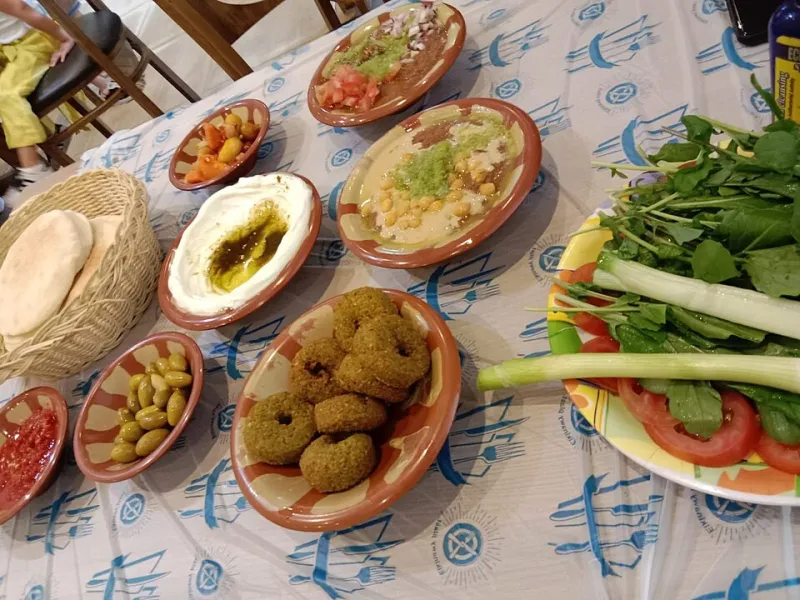
Photo: RubaMorsi, CC BY-SA 4.0, via Wikimedia Commons
The Question That Arrives Before the Appetizer
Ask a Lebanese American restaurateur in Houston whether the hummus on his menu is Lebanese and you will see the calculation happen in real time. The dish is on the menu. The word "Lebanese" may or may not be. That gap — between what a restaurant serves and what it is willing to claim — is where Middle East politics lives in the American dining room.
For the owners of the estimated eleven thousand Middle Eastern restaurants across the United States, every laminated menu is a negotiating table. Which country gets credited for falafel. Whether the shawarma is labeled Syrian, Palestinian, or simply "Middle Eastern." Whether the wine list exists at all. These are not branding decisions made in a marketing meeting; they are acts of quiet diplomacy, conducted under the fluorescent light of a kitchen printer.
Dearborn: Naming as a Statement
In Dearborn, Michigan — home to one of the largest Arab American communities in the country — the calculus runs differently than almost anywhere else. Here, a restaurant can name its politics openly because its customer base shares them. Owners describe the decision to print "Palestinian olive oil" on a menu as unremarkable within city limits and unthinkable in, say, suburban Atlanta.
One second-generation owner, whose father opened a bakery on Warren Avenue in 1989, puts it plainly: "My dad named dishes after villages. That was the whole menu. In Dearborn, that's not a risk. That's a love letter to people who know the names."
But even Dearborn's confidence has limits. During the flare-ups that periodically roil the region — a war, a ceasefire, a presidential statement — owners describe a familiar sequence: the phone calls, the online reviews that have nothing to do with the food, the quiet decision by some establishments to take down the flag in the window until the news cycle passes.
Bay Ridge: The Menu as a Truce
Brooklyn's Bay Ridge operates under different constraints. The neighborhood's Arab, Yemeni, Egyptian, and Palestinian establishments sit blocks away from businesses owned by Jewish New Yorkers, and the dining room is genuinely mixed. Here, several owners describe a deliberate strategy of vagueness. Falafel is "ours." The mezze are "from the region."
One owner of a shisha lounge on Fifth Avenue — who asked not to be named — explained the arithmetic. "If I write 'Palestinian' on the menu, half my customers feel seen and half feel addressed. If I write nothing, everyone eats. I have employees. I have a lease. I am not the embassy." The irony is not lost on him: in refusing to take a position, he has taken one, and he knows it.
San Diego and the Shisha Lounge as Consulate
In San Diego's El Cajon corridor, home to a large Iraqi Chaldean and Arab population, owners describe a stranger phenomenon: the restaurant as unofficial consulate. During regional crises, customers arrive not just to eat but to be near other people who understand. The television behind the register switches to Arabic satellite news. The owner becomes an amateur analyst, a grief counselor, sometimes a target.
"When something happens over there, my dining room becomes the reaction," one owner said. "People argue at table six. People cry at table two. And I'm standing there with a tray of kibbeh, trying to keep the peace in a room of forty opinions."
The Wine List Test
Perhaps no menu item carries more weight than alcohol. A dry menu signals observance and narrows the customer base. A full bar signals assimilation and risks the disapproval of the community that sustains the restaurant. Several owners described the compromise menu — beer and wine only, or a wine list heavy on California labels with a single Lebanese import — as the most honest document of assimilation they possess.
"The wine list is where I do my real politics," one Bay Ridge owner laughed. "Everything else is just dinner."
What the Menu Cannot Say
There is no neutral menu, the owners insist. Every omission is read by someone. Every credit is a claim in a contested culinary map that extends from the Levant to the diaspora's strip malls. What emerges from these interviews is a portrait of a community conducting foreign policy at the scale of a tabletop — cautious, pragmatic, and quietly fluent in the language of survival.
The next time a flare-up in the Middle East dominates the American news cycle, watch what happens to the menus. Dishes will be renamed. Countries will appear and disappear from descriptions. And somewhere in Dearborn, a owner will weigh the same question their parents weighed: how much of home can you afford to name?