Half-Sentences in Two Languages: What Gets Said in the Chair That Never Reaches the Papers
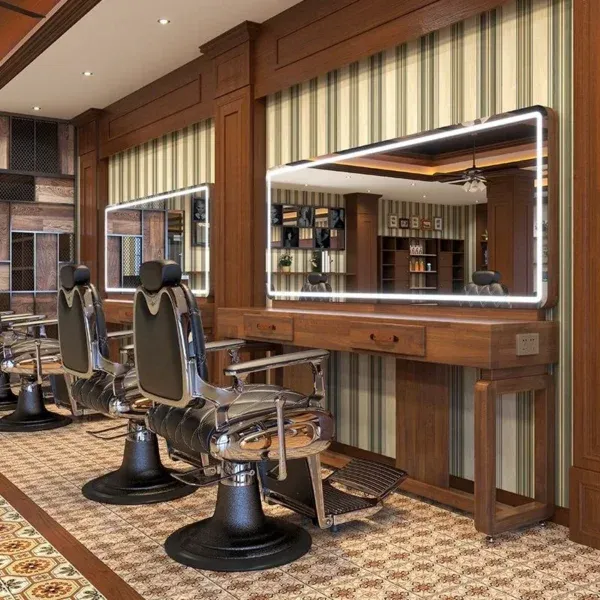
Photo: Arab American barbershop interior barber cutting hair mirror, via mi-mirror.com
The mirror in Samir's barbershop on Main Street in Paterson has seen three presidential elections, two wars in the Levant, and countless arguments that ended the way arguments in barbershops do — with a shrug, a laugh, and an invitation to come back next month. Nobody here is on the record. Everybody here is on the record. That paradox is precisely the point.
A Forum Without a Podium
Political scientists have a term for places where civic life happens informally: third places. But the Arab American barbershop is something more specific. It is a space where a man can say in Arabic what he would never risk saying in English, and where the English is often better for the thinking anyway. The switch between languages is not accidental — it is editorial. Customers code-switch to match the sensitivity of the subject, moving to Arabic for grief, staying in English for grievance.
The barber sits at the center of it all, scissors in hand, technically a participant and officially a neutral party. In practice, he is a moderator, an archivist, and occasionally the only person in the room willing to say the unpopular thing.
Three Shops, Three Temperaments
In Paterson, New Jersey — home to one of the largest Arab American communities in the country — the shop on Main Street leans toward the news of the day. The television is on Al Jazeera Arabic with the volume low, just enough to seed conversation. Debates about the midterm elections fold seamlessly into debates about conditions back in Ramallah or Amman. The customers here, many of them first-generation, treat voting less as a duty than as a negotiation: which candidate, which trade-off, which compromise with conscience.
In Anaheim, the tone shifts. The shops off Brookhurst Street serve a community that is, on the whole, a generation further along. The politics are less about the homeland and more about the school board, the housing market, the quiet anxieties of second-generation life. The barber here keeps a framed photo of his father's shop in Cairo behind the register — a reminder, he says, that assimilation is a slow haircut, not a single cut.
Dearborn is its own universe. Michigan's Arab American population is large enough that its barbershops function almost like precinct offices. In election seasons, candidates actually come through. Between cycles, the conversations turn inward and heavier. In the past two years, the war has hung over every chair like weather. Barbers describe customers who sit down and cannot finish a sentence. Others who talk for forty-five minutes about anything else. The half-sentence, trailed off into silence, is its own form of testimony.
What the Polls Miss
Surveys of Arab American political opinion tend to capture the community at its most performative — answering a stranger's phone call with the most defensible version of a belief. The barbershop captures the other version: the ambivalence, the family disagreement, the position revised twice before the clippers are cleaned.
One Dearborn barber put it this way: "At the mosque, people give the answer they think God wants. At the poll, the answer they think America wants. Here, they give the answer they're still working on."
That working-through matters. Opinions formed in the chair travel — to the dinner table, to the group chat, eventually to the ballot. The barbershop is not a substitute for formal politics. It is the draft stage of it.
The Economics of Listening
There is also a plainer truth underneath the civic romance: a barber's livelihood depends on repeat customers, which depends on making people feel heard. The chair is one of the few commercial spaces in American life where a stranger is physically captive for thirty minutes and socially obligated to talk. No algorithm has replicated that.
The shops themselves are small businesses navigating the same pressures as any Main Street storefront — rising rents, licensing boards, cashless-payment debates that quietly exclude some longtime customers. The politics of the barbershop are also the politics of the barbershop's survival.
Between Cuts, a Community
For an Arabic-speaking diaspora scattered across suburbs and strip malls, these shops do the quiet work of continuity. Grandfathers bring grandsons. The Arabic spoken over the clippers is often the only Arabic a second-generation kid hears all week. The gossip is the glue; the gossip is also, in its way, the record.
No one writes minutes. But ask any organizer, any city council candidate, any imam in Paterson, Anaheim, or Dearborn where sentiment actually turns, and they will tell you the same thing: check the barbershops first. The barber knows first. He just doesn't put it in a press release.