When the News Breaks, America Dials the Arabic Teacher
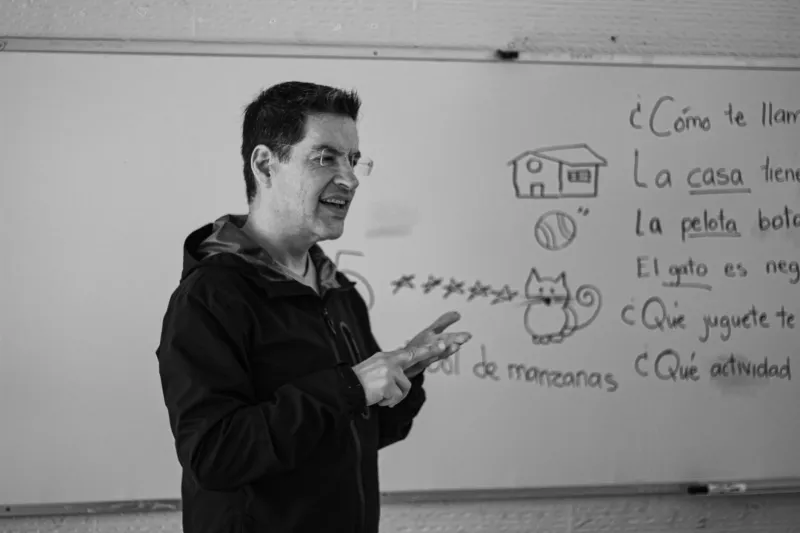
The voicemail arrived on a Sunday evening, minutes after the first breaking-news alerts lit up American screens. A producer from a regional television affiliate wanted fifteen minutes of Dr. Samira Haddad's time — a name she uses here with her permission, though she asked that her city remain vague. She teaches introductory Arabic at a community college in the industrial Midwest. She is not a policy analyst. She has never worked in government. But on nights when the Levant dominates the headlines, hers is one of the few local numbers reporters can find.
"They want the grammar of grief," she told me, describing the request. "They want me to pronounce a name correctly, then explain a war in one sentence."
The Accidental Press Corps
Across the American heartland, a small and largely invisible corps of Arabic language instructors — many teaching evening courses at community colleges, others volunteering at Islamic centers in Columbus, Dearborn, Kansas City, and the Twin Cities — have inherited a strange role. When a headline breaks, local newsrooms, school administrators, hospital PR offices, and even police departments reach for the nearest Arabic speaker. Not because that person is an expert, but because proximity has been mistaken for authority.
The pattern is well documented anecdotally among educators themselves, even if no one has tallied it formally. Instructors describe phone calls from anchors asking them to "translate the mood" of a region they left decades ago. School districts ask them to speak at assemblies. Interfaith groups request briefings. One instructor in Ohio recalled being asked by a county emergency-management office whether a particular Arabic phrase posted online constituted a threat — a question she answered by explaining, patiently, that it was a line from a popular song.
The pressure is not merely professional. It is interpretive, and it lands on people who never volunteered for it.
Fluent in Two Directions
What these teachers actually offer is subtler than translation. A dictionary can render a phrase; it cannot explain why a grandmother in Amman phrases something a certain way, why a term carries historical weight, or why an American audience keeps hearing a word that means something different in context.
That gap — between literal meaning and lived meaning — is where these instructors work. And it is where American news coverage of the Middle East most often stumbles. National outlets parachute correspondents into capitals; local outlets have no such budget. What they have instead is a community college classroom and an office phone.
The teachers, for their part, describe a double burden. They feel obligated to correct misinformation, yet wary of being drafted into advocacy. Several spoke of carefully rehearsing neutral phrasing before interviews, aware that a single imprecise sentence could follow them into the classroom, the parent-teacher conference, or the mosque board meeting.
Why Middle America, Specifically
There is a geographic logic to this phenomenon. Arab American communities outside the coastal metros are smaller, more dispersed, and less likely to include career spokespeople or established advocacy staff. In Dearborn, a reporter can find an institutional voice. In Springfield or Wichita, the search often ends at the local mosque's front desk or the community college's continuing-education catalog.
The result is an outsized reliance on a handful of individuals — often women, often immigrants who arrived in the 1980s and 1990s, often people who chose teaching precisely because it felt like a quiet, constructive form of service. Crisis converts them, temporarily, into public figures.
Some have come to accept the role, even value it. A well-chosen explanation on the ten o'clock news, they reason, may prevent a slur at the grocery store or a hostile question at a school board meeting. Others describe exhaustion, and a nagging worry that their presence lets institutions off the hook: why employ regional specialists when a volunteer will explain the region for free?
What It Reveals
The phenomenon says as much about America as about the Middle East. A nation of 330 million people processes the affairs of two dozen countries through a thin layer of trusted local intermediaries — the teacher, the imam, the shop owner — because trust, in American civic life, is hyperlocal. Expertise travels poorly across the dial; a familiar face travels well.
It also reveals an appetite. The calls keep coming, instructors say, because audiences genuinely want context, not just footage. Viewers ask follow-up questions. Students enroll in Arabic 101 after a news cycle ends, some of them saying they want to understand rather than merely watch.
Dr. Haddad returned the producer's call that Sunday night. She explained the vocabulary, corrected a mispronunciation, declined to predict the future. Then she went home and prepared Monday's lesson — the imperfect tense, as it happens, the grammatical space where unfinished things live.
"That is the job," she said. "Everyone else gets to conclude. We teach people to stay in the middle of the sentence."
In an era when the region's headlines arrive faster than anyone can translate them, Middle America's Arabic teachers remain at that middle — holding the language steady while the news rushes past.