Between Gates B14 and C2: How America's Airports Learned to Make Room for Prayer
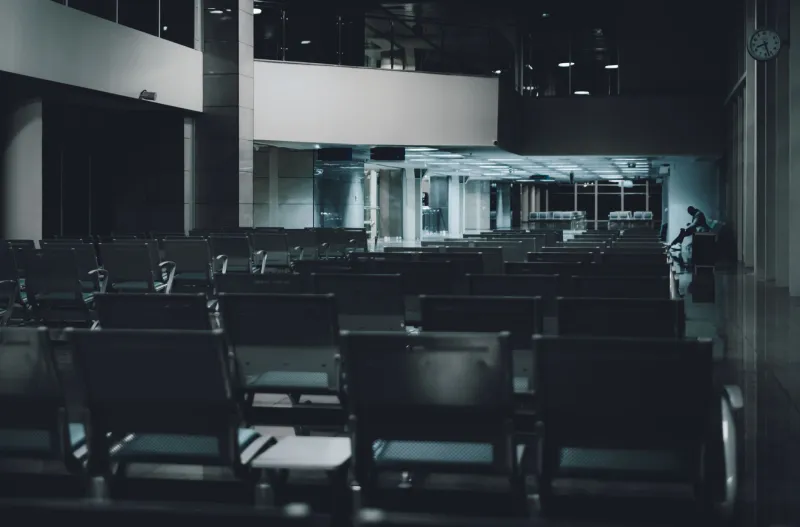
The call never comes from a minaret. At Gate B14 of a major American terminal, it comes from a phone — a quiet alarm set to Asr, checked against the departure board, weighed against the boarding group number flashing on the screen. For millions of Muslim travelers passing through US airports each year, the question is not whether to pray, but where.
The answers vary more than most travelers realize.
A Map Drawn by Accident
There is no federal mandate for prayer rooms in American airports, no master plan. What exists instead is a patchwork assembled over two decades, largely through the persistence of airport chaplains, Muslim employee associations, and the occasional interfaith advisory board.
New York's JFK, one of the busiest international gateways in the country, has long offered interfaith rooms scattered across its terminals — some little more than converted offices with a chair, a bulletin board, and a bottle of water. Frequent flyers trade notes about which terminal's room is clean, which has a workable qibla marker, which is locked after ten p.m. The information circulates the way diaspora knowledge always has: through group chats and word of mouth.
Houston's George Bush Intercontinental took a different route. Serving a metropolitan area with one of the largest Muslim populations in the South, the airport built dedicated reflection spaces that travelers describe as unexpectedly dignified — soft lighting, ablution facilities nearby, no requirement to explain oneself at a information desk.
Then there are the gaps. Travelers connecting through smaller hubs — a regional airport in the Carolinas, a midwestern terminal between concourses — often report improvising: a stairwell landing, a corner of the family restroom, a patch of wall near the baggage claim. One frequent business traveler from Dearborn described praying in a rental car shuttle lot, shoes in hand, while her ride idled nearby.
What a Room Says
An airport prayer room is a small thing — a few hundred square feet, at best. But accommodation in transit spaces has always been a barometer of belonging. Airports are the most public of public institutions: secular by design, shared by everyone, answerable to no single community. When they make room for worship, they are making a statement about who the traveler is presumed to be.
The history here is instructive. The chaplaincy movement in American airports grew largely out of Christian and, later, Jewish institutional support. Interfaith rooms multiplied after September 2001 — partly a gesture of inclusion, partly a security-era acknowledgment that Muslim travelers were not going away. The post-9/11 generation of Arab American and Muslim American travelers remembers both impulses: the new rooms, and the extra screenings that sometimes preceded them.
Today's landscape reflects that layered history. Some rooms feel like an afterthought; others, like the newer reflection spaces in Dallas and Seattle, were designed with input from Muslim employees and get the details right — foot-washing stations, unmarked entrances for privacy, clocks aligned to prayer times rather than just departure boards.
The Five-Minute Congregation
Spend time in these rooms and you notice something the architects probably did not plan: they are among the last genuinely mixed spaces in American Muslim life. A Yemeni American salesperson from Oakland might stand beside a Nigerian student, a Pakistani American pilot, a white convert from Ohio. Strangers line up shoulder to shoulder at noon in a room with no windows and a view of nothing but carpet.
There is a particular etiquette to the airport prayer — compressed, efficient, alert to the boarding announcement overhead. The imam keeps the recitation short. Nobody lingers in the sunnah prayers when the gate agent starts the pre-boarding announcement. It is devotion under time pressure, and veterans of it describe a strange calm: the airport is a place designed to make people anxious, and prayer is, among other things, a technology for refusing anxiety.
The rooms also serve travelers who are not praying. Airport chaplains report that interfaith rooms host meditation, nursing mothers, passengers with sensory sensitivities, and the simply exhausted. The space absorbs whoever needs stillness.
The Unfinished Work
Advocates acknowledge the gaps. A 2019 survey of the hundred busiest US airports found prayer or meditation rooms in fewer than half — and ablution facilities in far fewer. For a country through which hundreds of thousands of Muslim travelers pass daily, the infrastructure lags well behind the reality.
The diaspora is changing that, the way it usually does: by asking, politely and repeatedly. Muslim employee groups at several airlines and airport authorities have pushed for dedicated spaces in new terminal construction. Architects who specialize in aviation design now list reflection rooms among standard amenities, the way nursing rooms became standard a generation ago.
Whether that progress reaches the smaller airports — the ones where the choice is between a stairwell and a missed prayer — remains the open question. But the direction is clear. The traveler at Gate C2, phone alarm silenced, forehead to the carpet between two departures, is no longer an anomaly to be accommodated. Increasingly, the room is simply there.
That, in the long arithmetic of American belonging, counts as progress measured in square feet — and in the quiet relief of not having to ask twice.