The Whistle Blows in Two Languages: A Season on the Sidelines With America's Arab American Youth Soccer Referees
The First Call of the Season
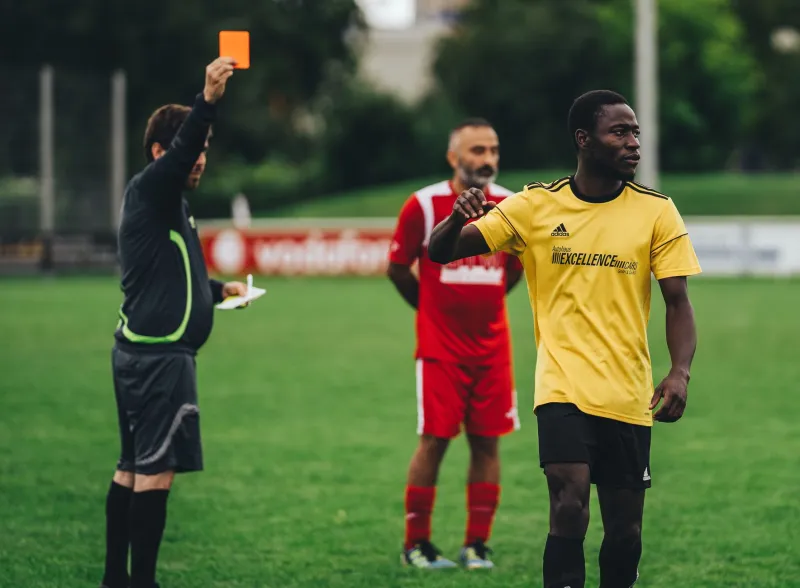
The whistle sounds at 9:04 on a Saturday morning in Dearborn, and before anyone has touched the ball, a father on the visiting side is already standing up. Not angry — just standing, the way men stand when they are deciding whether a matter is worth becoming a matter. The call was offside. The call was, by the letter of the law, correct. What follows is fifteen seconds of negotiation conducted half in English and half in Arabic, and by the time it ends, the referee has been addressed as hakam, sir, and, once, by his American surname pronounced in a way his grandmother would not recognize.
I spent last spring and fall following volunteer referees and coaches through suburban leagues in New Jersey and Michigan, watching youth soccer from the only vantage point that sees everything and controls nothing: the sideline. What I found was not a story about sports. It was a story about the first public square where immigrant families in America test how visible they are willing to be — and how visible everyone else will allow them to be.
Where the Rules Meet the Real Life
Every league has a rulebook, and every rulebook says roughly the same thing about religious headwear: a hijab is permitted if it is safe, secured, and does not endanger the player. The words are clean. The application rarely is.
In one New Jersey township league, a coach recounted a match in which a referee from an out-of-town association asked a twelve-year-old girl to remove her hijab because her hair tie under it was, in his judgment, a hard object. Her mother did not argue. She walked to the car, returned with the league's printed policy, and handed it over like a subpoena. The girl played. Nothing else was said. "That," the coach told me, "is assimilation in America. You don't get a speech. You get a printout."
These are small incidents, and it is tempting to treat them as such. But for families who arrived here within the last decade, the sideline is often the first American institution they encounter weekly, in person, with their children on the line. The referee's ruling on a head covering may be the very first time the state — in its most miniature, volunteer-driven form — renders judgment on how Muslim or Arab their household intends to be in public.
The Snack Bar as Border Crossing
Then there is the snack bar, which sounds like a joke until you watch it operate.
At a tournament in suburban Detroit, the concession stand offered the standard American canon: Gatorade, chips, hot dogs. Two seasons ago, a parent volunteer — a Palestinian American mother of three — began bringing manaeesh on weekend mornings. She sold out by the second week. By the fourth week, the league board was debating whether "outside food" violated vendor agreements, a debate that everyone involved understood was about something else entirely.
The compromise, eventually, was that the manaeesh became official. It is now on the laminated menu. This is how change actually happens in suburban America: not through protest but through repeat customers. The snack bar is a tiny border crossing, and the toll is paid in za'atar and Venmo.
Similar negotiations play out over the team potluck, that most sacrosanct of American youth rituals. Whose dish gets labeled "main course" and whose gets labeled "side"? Who brings a dish at all, and who quietly orders pizza? Coaches in both states told me the potluck roster tells them more about a team's social dynamics than any practice ever has.
What's in a Name, Spelled Correctly
Referees keep score sheets, and score sheets require names. Here the diaspora's oldest bureaucratic wound reappears on carbon paper: the name shortened, respelled, or replaced. One referee in Michigan described his personal policy — he asks every player, on first meeting, how their name is pronounced, and he writes it phonetically on his card. "It takes ten seconds," he said. "Ten seconds versus a kid hearing their name butchered for an entire season."
It is a small pedagogy. But children notice which adults bother. Several parents told me their kids could not articulate why they preferred certain referees — only that some of them "got it."
The Long Whistle
What emerges from a season on the sidelines is a picture of assimilation that neither the anxiety merchants nor the celebration merchants quite capture. It is not a one-way road and it is not a fortress. It is a running negotiation, conducted in two languages, over uniforms and snacks and pronunciation, game by game, season by season.
The Arab American families in these leagues are not asking for a parallel world. They are asking, mostly, to be refereed by the same rulebook as everyone else — with the understanding that the rulebook, like the snack bar menu, can grow one item at a time.
The whistle, it turns out, does sound different in two languages. Not louder. Not softer. Just heard by two audiences at once, both waiting to see what the call will be.