The Roadside Argument: How Arabic and English Billboards Turned American Highways Into a Diaspora Forum
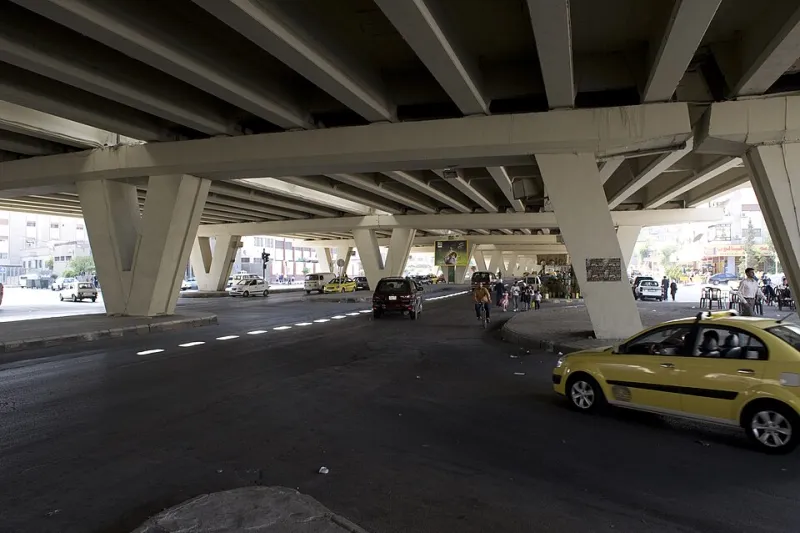
Photo: Dosseman, CC BY-SA 4.0, via Wikimedia Commons
At the interchange where Interstate 94 meets Exit 9, the billboard rises above a stand of bare November trees. Its top line is in Arabic; its bottom line, in English. It does not advertise a restaurant, a lawyer, or a car dealership. It asks passersby to consider a phrase about civilian protection in the Levant. The sign is one of dozens that have appeared along American highways in 2026, purchased by diaspora organizations that have decided the roadside is a place to argue about the Middle East.
The New Signage of Belonging
For years, the visible politics of Arab America lived in mosque parking lots, community centers, and the comment sections of diaspora news pages. The billboard changes the scale. A message that once circulated among people who already agreed with it now meets tens of thousands of drivers who may have no connection to the region. In Michigan, New Jersey, Illinois, and Ohio, organizers have booked space on interstate corridors where the audience is mixed: commuters, truckers, shoppers, and voters. The signs are not uniform. Some are in Arabic only, a signal to the community that a campaign exists. Others are in English, an appeal to a broader public. A few are bilingual, with the Arabic and English versions carrying slightly different emphases.
The groups behind the signs are equally varied. Some are registered nonprofits with small budgets and volunteer designers. Others are ad hoc committees formed around a single vote in Congress or a single outbreak of violence. Several organizers interviewed for this article described the same learning curve: a billboard is not a newspaper op-ed. It has three to seven seconds to land. The text must be legible at 65 miles per hour. The image must survive rain, glare, and the indifference of a driver who is thinking about dinner.
Who Pays for the Space
The money is rarely glamorous. Organizers describe WhatsApp fundraisers, Friday collection baskets, and checks from small family foundations. A typical highway placement can cost between $4,000 and $18,000 a month depending on the market, according to outdoor advertising professionals who spoke generally about rates. That is enough to require a committee, a bank account, and a bookkeeper. It is not enough to buy the kind of saturation campaign that a corporate brand would run. The result is a politics of scarcity: one sign in a strategic county, one month at a time.
Who pays matters because the billboard is a public claim. A sign purchased by a mosque may be read as the voice of a congregation. A sign purchased by a 501(c)(4) social welfare organization may be read as the voice of a movement. A sign purchased by an anonymous LLC may be read as the voice of no one in particular, which is its own kind of message. In 2026, several diaspora groups have begun disclosing their billboard budgets on their websites, partly to preempt the accusation that foreign money is behind the signs. Organizers say the disclosures are also a response to a more mundane problem: donors want to know what their money bought.
Testing the Message on Strangers
The most revealing part of the billboard boom is the testing. Campaigns that once relied on instinct now convene focus groups, sometimes in church basements or hotel conference rooms, to show draft designs to people who are not Arab and not Muslim. The questions are practical. Does the English line sound like a slogan or a threat? Does the Arabic script make the sign feel closed to outsiders? Is the child in the photograph too young, too old, too passive? One organizer in suburban Detroit described a panel of forty drivers recruited through a local civic group. The draft that tested best was the one that said the least. It named a principle, not a faction. It used a verb in the active voice. It left the viewer with a question rather than an accusation.
That testing has limits. A billboard cannot explain a war. It cannot footnote a claim. It cannot answer the driver who calls the number on the sign and reaches a volunteer who is tired. Organizers know this, and some worry that the medium rewards the wrong things: brevity over accuracy, emotion over evidence. Yet they also argue that the alternative is worse. For decades, they say, the American roadside has carried billboards about other people's conflicts, other people's famines, other people's elections. The Arabic-language sign is a claim on the same space.
The View From the Zoning Office
Local officials have responded with a mixture of procedure and caution. Billboard content is generally protected speech, and zoning boards regulate size, lighting, and placement rather than message. That legal line has held in 2026, but it has not prevented complaints. A township supervisor in Macomb County said his office received calls from residents who found one sign divisive. The supervisor declined to describe the sign's content, saying the office does not adjudicate political messages. A free-speech advocate in New Jersey put the matter more plainly: the remedy for a billboard you dislike is another billboard, not a permit denial.
That remedy is already being used. Counter-campaigns have appeared in the same corridors, sometimes within weeks. The result is a visual argument conducted at highway speed, with each side buying the same 14-by-48-foot rectangle. It is expensive, imprecise, and unmistakably American. It is also, for a diaspora that has often been spoken about rather than spoken to, a new kind of political grammar.
The Limits of the Medium
The billboard cannot settle the arguments it raises. It can only announce that the argument exists. For the Arabic-speaking diaspora, that announcement has value. It says that the Middle East is not a distant subject reserved for foreign correspondents. It says that the people who live here have opinions about the place they came from, and that those opinions belong in the public square. The sign off Exit 9 will come down in a few weeks. Another will take its place. The question is whether the conversation it starts can survive the drive home.