Laughing Past the Checkpoint: Inside the Clubs Where Arab America Rehearses Its Politics
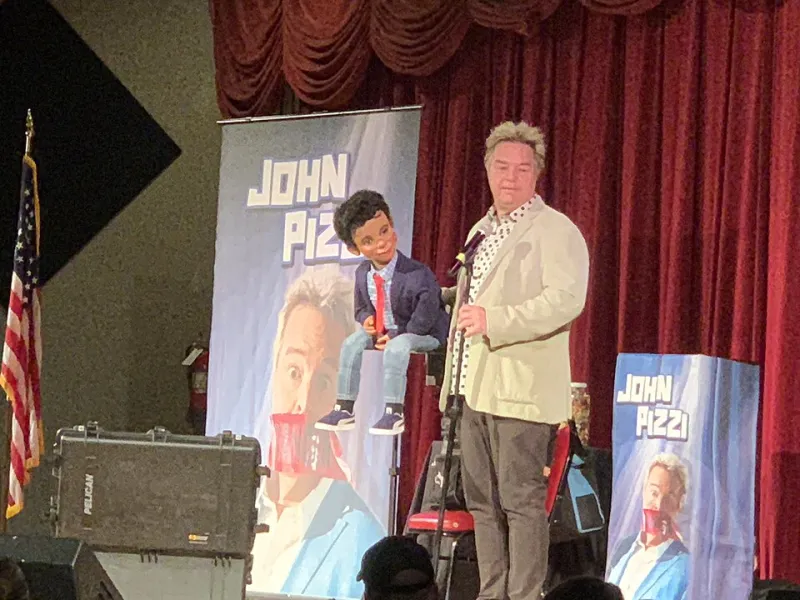
Photo: Jason Ingtonn, CC BY-SA 4.0, via Wikimedia Commons
The room is small, the ceiling is low, and the brick wall behind the mic stand could belong to any American city. On a Tuesday night in Chicago's Logan Square, the lineup reads like a diaspora roll call: a Palestinian engineer from Skokie, a Lebanese-American nurse who drove in from the suburbs, an Egyptian-born host who opens every show with the same joke about his mother's opinion of American air conditioning. What follows is something the opinion pages have struggled to produce for two decades — a sustained, honest argument about Arab American life that people actually line up to hear.
The Five-Minute Op-Ed
Stand-up comedy has always functioned as an unofficial public square, but for Arab Americans the stakes feel different. When a comedian jokes about being pulled aside for extra screening at O'Hare, she is doing something a columnist cannot: making the audience laugh at an indignity before they can decide how to feel about it. The laugh comes first; the recognition arrives a beat later. That sequencing — humor preceding politics — is precisely what makes the club a more permissive space than the editorial section.
Several working comedians describe their sets as a kind of translation service. The material is drawn from the same tensions that fill Arabic-language group chats: the parents who fled a war and now fear a mall Santa, the cousin in Dearborn whose name triggers an algorithm, the aunties who treat a career in comedy as a diagnosis. Delivered from a stage, these become more than anecdotes. They become a shared record of what it feels like to be simultaneously hyper-visible and misunderstood.
Detroit's Basement Circuit
Dearborn and greater Detroit host what may be the most concentrated Arab American comedy scene in the country. Shows run in rented halls, coffee shops on Warren Avenue, and the back rooms of restaurants that clear tables by nine. The audiences are mixed — Arab and non-Arab, first generation and fourth — and that mix shapes the material. A joke about a grandmother's reaction to a dating app lands differently when half the room has the same grandmother.
What distinguishes the Detroit scene is its intimacy with the audience's own lives. Comedians here are not explaining their community to outsiders; they are performing for it. The result is material with an insider's precision: the negotiation over who pays the check, the strategic deployment of a parent's limited English in a traffic stop, the way a family WhatsApp group becomes a parallel news network. These are not bits about being Arab American in the abstract. They are bits about specific kitchens, specific mosques, specific exits off the interstate.
Where the Punchline Crosses the Line
Not everything lands. The community's internal debates — over politics back home, over religion, over how much of the immigrant story belongs on stage — follow comedians off it. Several performers describe being approached after shows, sometimes warmly, sometimes less so, by audience members who felt a particular joke went too far. Marriage. Faith. The wars. The word itself — the one that starts with an occupation and ends in an argument.
The tension is generational as much as topical. Parents who arrived with little and built much can hear self-deprecating material as airing dirty laundry. Their American-raised children hear it as the opposite: a refusal to be diminished. Between those positions sits the working comedian's nightly calculation — how much truth a room can hold before it stops laughing.
Why the Clubs Beat the Comment Sections
There is a structural reason comedy is outpacing formal commentary on these questions. An op-ed argues; a joke implicates. When a comedian mines the absurdity of being asked "where are you really from," the audience is not presented with a position to accept or reject. They are placed inside the moment, briefly, and asked to laugh at its logic. That is a more efficient political education than a thousand-word explainer.
It also travels differently. Clips from Arab American comedians circulate through the same diaspora networks that carry recipe videos and homeland news — reaching second cousins in Vancouver and uncles in Amman with a speed no newspaper can match. The commentary becomes communal property, argued over in comments and forwarded with a laughing emoji that functions as an endorsement.
The Long Set Ahead
The scene is still small. There is no Arab American comedy institution, no late-night pipeline, no equivalent of the comedy factories that shaped earlier immigrant humor. What exists instead is a distributed network of rooms — Chicago, Detroit, Los Angeles, New York, Houston — where performers test material that is, in effect, a running draft of the community's self-portrait.
That draft is messier than anything a single publication could produce, and more honest for it. The comedians are not speaking for Arab America; they are speaking from it, one tight five at a time. And if the past few years prove anything, it is that the rooms are getting bigger, the jokes are getting sharper, and the line everyone argues about keeps moving — usually toward the truth.