Three Minutes at the Microphone: How Dearborn's Poets Are Rewriting the Middle East Debate
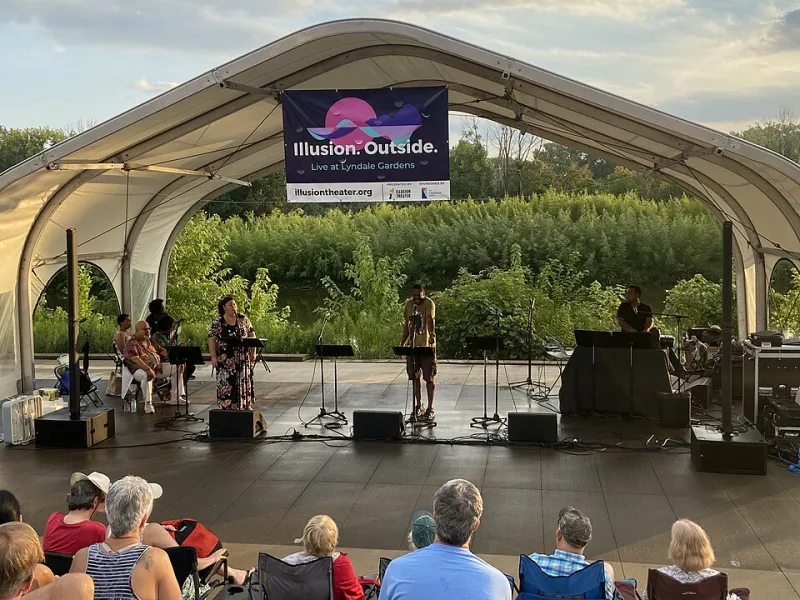
Photo: Myotus, CC BY-SA 4.0, via Wikimedia Commons
The room smells like cardamom tea and printer ink. It is 9:40 on a Thursday night in Dearborn, and the open mic list at the back of the warehouse has run out of blank lines — twenty-six names, scrawled in a mix of English and Arabic, for a slot list that was supposed to hold fifteen.
The host, a nineteen-year-old community college student named Rania, taps the microphone twice and delivers the only house rule of the night: "Three minutes. Say what the news won't."
They do. Night after night, they do.
The Scene the Cameras Skipped
Mainstream America discovered Arab American political expression in the usual ways — rallies, congressional testimony, the occasional earnest morning-show segment. What television keeps missing is quieter and far more consequential: a spoken-word circuit that runs from basement venues in Dearborn to storefront galleries in Chicago's Albany Park to a converted mosque annex in Brooklyn, where the region's wars are rendered not as talking points but as three-minute acts of witness.
The poets themselves are mostly in their twenties. Many are children or grandchildren of immigrants from Lebanon, Palestine, Iraq, and Yemen. They grew up bilingual in the particular dialect of the diaspora — fluent in Arabic at their grandmother's table, fluent in American at school, and fluent in the exhausting work of translating between the two.
That translation, it turns out, is the whole art form.
Three Poets, Three Cities
Consider the circuit through three performers.
In Dearborn, there is Sami, a twenty-six-year-old whose set that Thursday night began with a recitation of his father's naturalization oath and ended, ninety seconds later, with the oath read backward. The audience understood immediately: the country he was joining was also, in some sense, asking him to un-remember where he came from. Nobody clapped right away. They let the silence finish the poem.
In Chicago, Layla performs with a notebook of headlines she has been collecting since she was fifteen — every front-page phrase used to describe her grandparents' hometown, every euphemism, every passive construction. Her signature piece strings the headlines together until they collapse under their own weight, then answers them with a single line in Arabic that the room, mostly, understands without translation.
And in Brooklyn, a poet who goes only by M. closes every set with the same gesture: he reads the names of villages from an old family land deed, slowly, as though reading a roll call. It is not a protest. It is closer to a prayer that refuses to stay in the mosque.
Why Verse Outperforms the Panel
There is a reason a three-minute poem can land harder than an hour of cable commentary. Panels trade in balance; poetry trades in precision. A pundit must hedge. A poet must not.
The diaspora audience feels the difference viscerally. For decades, Arab Americans have watched their region described in a vocabulary they didn't choose — "the street," "the conflict," "escalation" — a lexicon that flattens the places their families actually come from. Spoken word hands the vocabulary back. When a Dearborn poet names a street in Beirut or a bakery in Gaza, she is doing something no news desk can: restoring the specific to the discussion of the general.
There is also the matter of audience. The open mic is one of the few American spaces where a young Arab American can assume, rather than explain, the context. No one asks for a history lesson. No one interrupts. The three-minute clock is the only gatekeeping, and it applies to everyone equally.
A Generation's Political Curriculum
Talk to the regulars long enough and a pattern emerges: the scene functions as a kind of informal civics seminar. Kids who came for the atmosphere leave with a working vocabulary of dispossession, exile, and citizenship — not from a lecture, but from watching a peer put their family's experience into language for the first time.
Several performers describe the moment they first attended as the moment politics became personal rather than inherited. One Chicago poet put it plainly: "At school, the Middle East was a unit in a textbook. Here, it's a guy my age talking about his uncle's apartment. Which one do you think I'm going to remember?"
That is not to say the scene is monolithic. Arguments break out — about religion, about assimilation, about which grievances belong on stage and which belong at home. The mic does not resolve them. It hosts them, which in this era of algorithmic echo chambers may be its own quiet achievement.
The Mainstream Keeps Missing It
Why hasn't this scene become a media fixture? Partly logistics — the venues are small, the performances unrecorded, the language often mixed. Partly a deeper habit: American media treats Arab American expression as reactive, something that appears in response to a crisis, rather than as a continuous cultural life that simply gets on with its work between headlines.
But the work continues regardless. Next month the circuit adds stops in Houston and Minneapolis. Rania's sign-up sheet, she says, now needs a second page.
And somewhere in Dearborn, a poet is timing a new piece against the second hand of a phone clock, trimming a syllable here, a headline there — getting it down to three minutes. It is, arguably, the most efficient commentary on the Middle East being produced in America today. It just doesn't come with a chyron.