The Annotated Ballot: Arabic-Language Voter Guides and the 2026 Midterms
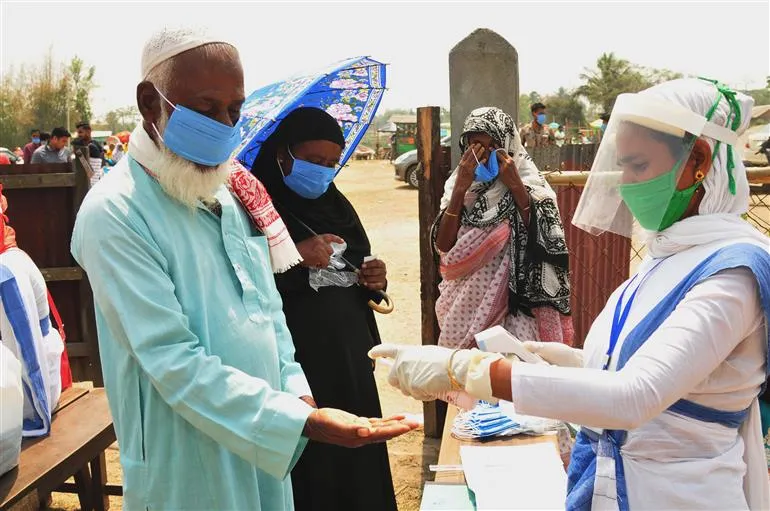
Photo: Election Commission of India, GODL-India, via Wikimedia Commons
The volunteer at the folding table had a laminated sample ballot and a black binder full of translations. It was a Saturday morning in Dearborn, and the line moved slowly — not because anyone was undecided, but because the ballot itself had become the obstacle. Two proposals, a judicial retention section, a library millage, a congressional race. Each needed an Arabic sentence that would not mislead, and the volunteers had spent the previous week arguing over how to render "millage" without making it sound like a levy nobody had voted for.
That scene has repeated itself across the country this fall. With control of the House in play and an open Senate seat in Michigan drawing national money, Arabic-language voter education has moved from the margins of diaspora civic life to something closer to an industry. County clerks print translated sample ballots. Nonprofits produce explainer videos with burned-in Arabic subtitles. Mosque social committees, which five years ago distributed nothing more political than a Ramadan calendar, now circulate candidate questionnaires.
A Guide, Not a Ballot
The distinction matters legally, and the people making these materials know it. Organizations operating under section 501(c)(3) may conduct voter education and encourage participation, but may not endorse candidates. That line, sensible on paper, is porous in practice. A guide that lists a candidate's position on civil liberties in heavily annotated detail is not technically an endorsement. It is also not nothing.
Most of the groups producing Arabic-language guides describe their work in defensive terms: they are correcting a vacuum, not shaping an outcome. The official voter guide mailed by a state elections office is often available in Arabic but written in a formal register that assumes civic vocabulary many first-generation readers do not have. Arabic diglossia is not a small technical problem. A voter may speak a Levantine or Egyptian dialect at home, read Modern Standard Arabic with effort, and encounter a translated ballot whose key term — "affidavit," "bond proposal," "retention" — has no everyday equivalent in any dialect at all.
The practical result is a genre of document that is part translation, part civics lesson, part glossary. Some outlets have begun producing video walkthroughs instead of text, on the theory that a forty-year-old who never attended school in the United States will watch eight minutes of explanation before reading two pages of prose.
The Geography of Translation
The map of this activity is not the map of Arab America as a whole. It follows competitive districts.
In Michigan, the guide business is concentrated around Wayne County and the downriver suburbs, where a Senate race without an incumbent has pulled resources into every ward. In Virginia, the congressional districts that include Annandale and the Fairfax County corridor have drawn translated materials from both party committees and from nonpartisan groups that had previously limited themselves to citizenship classes. Ohio, Pennsylvania and Illinois have smaller but visible efforts.
What varies most is who is doing the work. In some places it is a legacy Arab American newspaper with an editorial board and a printing press. In others it is a WhatsApp network administered by four people and a treasurer. The first has institutional memory and a libel exposure problem; the second has reach and no formal correction policy. Both are now consequential.
The Endorsement Question
There is no consensus within the community about where education ends and advocacy begins, and the disagreement is not always polite. Editors at Arabic-language outlets argue that community media has always endorsed, in Arabic, going back decades — that refusing to do so now would be a strange form of deference. Nonprofit directors counter that a guide circulated through a mosque listserv will be read as authoritative in a way a newspaper editorial never is, and that the trust being borrowed is religious.
A quieter concern is accuracy under deadline. Candidate questionnaires arrive late, answers are paraphrased, and a single mistranslated clause about immigration enforcement can circulate for weeks before anyone catches it. Several groups have started building internal review: two translators, one reader with no prior knowledge of the race, and a rule that no claim about a candidate appears without a direct citation to something the candidate said or wrote.
Measuring What Moves
Whether any of this changes turnout is, candidly, unknown. Arab Americans are not counted as a discrete group in federal voting statistics, so estimates rely on precinct-level analysis and surname-matching studies — methods that are useful and imperfect. Researchers who have run the numbers in past cycles find modest effects from translated materials, concentrated among voters who were already registered and already likely to vote, with the largest gains among naturalized citizens in their first two or three federal elections.
That is a real effect, but a narrow one. The larger barrier identified in survey after survey is not language comprehension but confidence: a belief that the ballot is legible, that a mistake will not invalidate it, that the poll worker will be patient. A guide addresses the first problem. The second is settled in a parking lot at seven in the morning.
The Limits of Legibility
What the 2026 cycle has clarified is that the Arabic-language voter guide is no longer an emergency measure improvised by a handful of volunteers. It is a standing institution, with its own ethics, its own internal arguments, and its own capacity to embarrass the people who make it.
That is, on balance, a development worth watching closely rather than celebrating quickly. A community that once had to be told what was on the ballot now argues about how to explain it — and about who has the standing to do the explaining. The argument is the healthiest thing in the room.