Who Gets to Say Halal: The Labeling Fight That Taught Arab American Grocers to Lobby
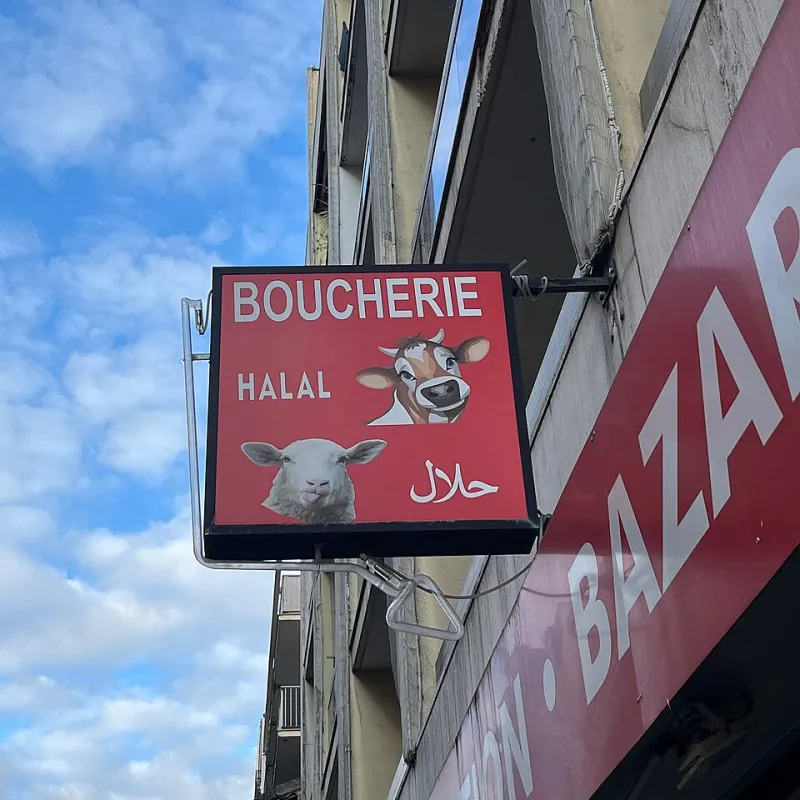
Photo: Astacoid, CC BY-SA 4.0, via Wikimedia Commons
The coalition began, as these things often do, in a group chat. A grocer in Dearborn forwarded a notice about a proposed federal rule on halal labeling. Within a week the chat had a butcher from Paterson, a distributor outside Chicago, two imams, and a lawyer who had volunteered to read the actual text. Within a month they had drafted comments for the public rulemaking docket, and a handful of them were on a call with staff from the Department of Agriculture.
For a community frequently described as politically invisible in Washington, this was an unusual sequence. Halal labeling is a narrow regulatory question — what a package may claim, and what substantiation stands behind the claim — yet it has become a test case for whether Arab American institutions can act as an interest group rather than only as a constituency to be courted every two years.
A Rule About Ink and Slaughter
The dispute is technical on its face. A halal claim on a food label is a representation about how an animal was raised and slaughtered, and under federal food labeling law such claims must be truthful and not misleading. The question regulators have wrestled with is evidentiary: what documentation suffices, who may issue it, and whether a private certifier's seal is enough.
The proposal that circulated this year would tighten the standard for substantiating halal claims on federally inspected products, in line with the approach taken toward other religious and ethical claims. Supporters describe it as consumer protection. Critics describe it as an attempt to impose a single audit model on a practice that has never had one.
The Certifiers
In the United States, halal certification is a private market. A few large bodies dominate, issuing seals recognized by exporters and by retailers who need to reassure customers at scale. Alongside them are smaller certifiers, some attached to mosques, some attached to importers, some essentially one inspector with a clipboard and a reputation.
This plurality is both the system's strength and its vulnerability. It allows a Somali restaurant, a Lebanese butcher and an Indonesian importer to each operate under standards their own communities accept. It also allows fraud. State attorneys general have pursued cases in which products labeled halal were nothing of the sort, and the enforcement record is thin because the people most likely to detect a violation are least likely to file a complaint about a business they depend on.
Grocers, for their part, occupy an uncomfortable position. A supermarket buying certified beef cannot independently verify what happened at a slaughterhouse three states away. It relies on paperwork. When that paperwork is generated by a certifier with a financial interest in approving the supplier, the seal becomes a business arrangement wearing religious clothing.
The Imam in the Middle
The most difficult objections have come from clergy, and they are not uniform. Some imams welcome a federal floor, arguing that religious authority has been quietly subcontracted to certifying agencies whose rulings on stunning, mechanical slaughter and the invocation pronounced at the moment of killing vary widely. Others see the rule as an intrusion: a government agency deciding which reading of a contested practice gets to be printed on a package.
There is a practical dimension as well. Certification fees are real, and they fall hardest on small operators. A halal butcher in a strip mall who slaughters on site and sells to neighbors he has known for twenty years may now need documentation designed for a company shipping pallets across state lines. Several grocers interviewed for this piece made the same point in different words: the rule protects the consumer at the supermarket and squeezes the shop that never had a labeling problem to begin with.
Grocers as Lobbyists
The comment docket closed with an unusually heavy volume of submissions from Arab American businesses, many of them brief, many of them translated or drafted with help from a mosque office. The coalition's formal asks were modest: a longer compliance window, recognition of multiple certification models, a small-business exemption, and clearer guidance on what a retailer must keep on file.
What was more revealing was the process. Participants describe learning, in real time, how a federal rule is made — that a comment period is not a petition, that agency staff read for specificity, that a trade association can say things a religious nonprofit cannot. Several said they had never before contacted a member of Congress about anything other than immigration, and one distributor noted dryly that the first federal office he ever visited was not the one he expected.
What Counts as Proof
The tension at the heart of the matter is not really about food. It is about who holds interpretive authority in a diaspora community that has no central religious hierarchy and no interest in acquiring one. A certification regime works by standardizing. A religious tradition works by arguing. Any rule that requires documentation will inevitably privilege the certifiers who can produce it, and over time that shifts practical authority away from the mosque and toward the auditor — a consequence nobody in the docket described as intended.
The Broader Aisle
The outcome will not stay inside the halal section. Kosher certifiers, vegan and organic trade groups, and importers of every confessional label are watching how the agency defines sufficient evidence. The precedent being set concerns religious claims generally, and it will be cited the next time a state legislature takes up labeling.
For the grocers, the more durable result may be organizational. A community that once appeared in Washington mainly to discuss visas now has a working knowledge of the Federal Register, a list of contacts at two agencies, and a shared archive of comments already filed. Whether that capacity gets used for anything beyond the meat case is, as one participant put it, up to whoever finds the next notice.